
Beaumont, CA · Garage Door Service
Garage Door Repair for Beaumont's 1968-2000 Housing Stock
Beaumont homes built 1968-2000 carry original torsion and extension hardware. Here's what moderate heat does to that stock and when a repair call is worth it.
- Repairs & new doors
- Springs & openers
- Serving 5 nearby communities
What the Weather Here Does to It
Beaumont sits in a moderate heat band, not the low-desert extremes you'd find ten to twenty miles east toward Cabazon or Sage. That still matters for a garage door. Steel sectional panels expand and contract through the day, and on a door that's been cycling since the 1980s or 90s, the galvanized coating on the torsion spring starts to lose its give. The spring doesn't snap from cold here the way it might up in the mountains near Idyllwild-Pine Cove. It fatigues from heat cycling - expanding on a 95-degree afternoon, contracting overnight, year after year. That's metal fatigue, not a single event, and it's why a spring on an original-era door can go without warning on an otherwise ordinary day. Nylon rollers and plastic idler bearings also degrade faster under sustained heat exposure than people expect. If your door is original to a house built when this area was mostly getting built out - the 1968 to 2000 window that covers most of the service territory - the hardware has had decades of exactly this cycling. None of this means the door is unsafe to use right up until it fails. It means the failure, when it comes, tends to be sudden rather than gradual.
The Problem
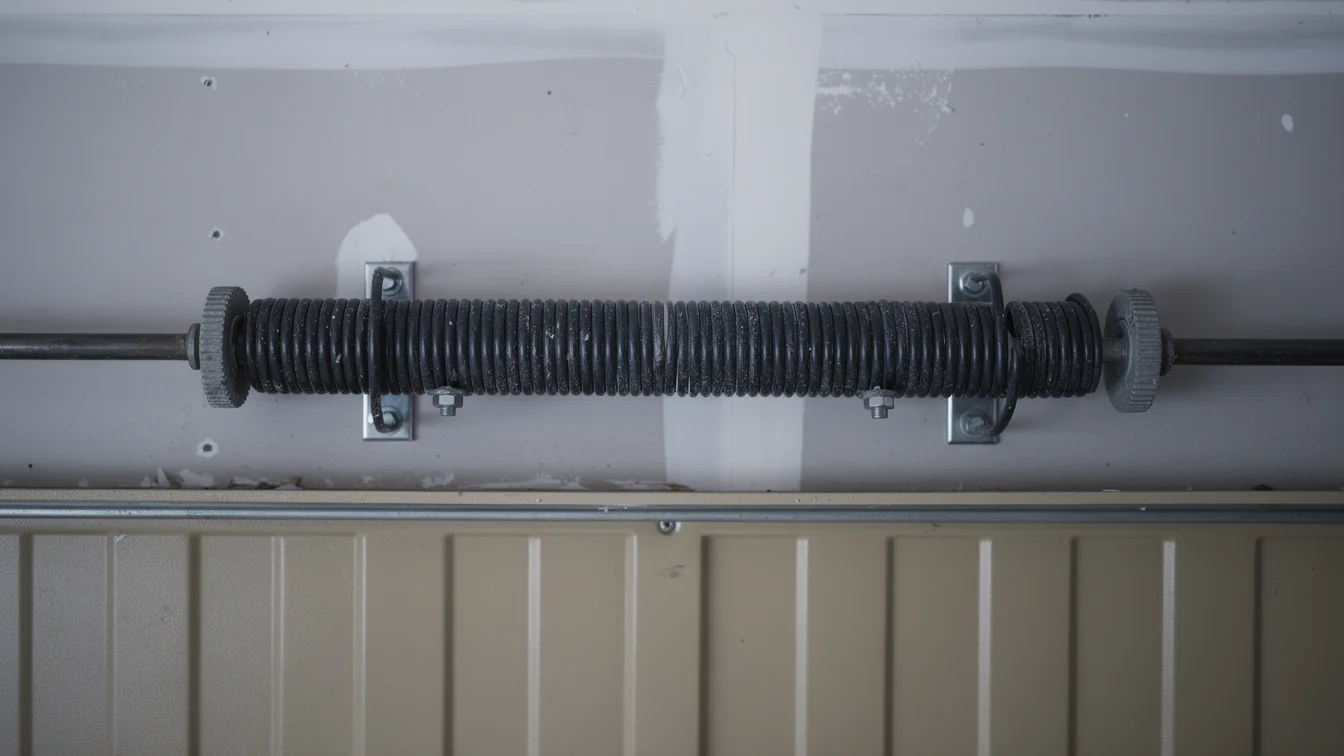
Most of the houses this shop works on went up between 1968 and 1982, the median year for the roughly 36,284 owner-occupied homes across the service area. That's a specific problem: torsion springs from that era were often side-mounted, undersized for today's heavier insulated panels, and matched to openers that have since been replaced two or three times over without anyone upgrading the spring to match. Across the eighteen named communities this truck covers - Banning and San Jacinto six miles out, Cherry Valley seven, Calimesa and Valle Vista ten - the housing is overwhelmingly 1980s and 90s construction, which means a lot of doors are running original or first-generation replacement springs that were never sized for current door weight. The symptom shows up as a door that opens fine by hand but strains or reverses under opener power, or a cable that frays faster than it should because the spring isn't carrying its share of the load anymore. It's not a weather problem on its own. It's thirty-plus years of heat cycling on hardware that was already working at the edge of its rating.
When to Get Help
Call before the spring goes all the way, not after. A spring under heat-cycle fatigue usually gives you signs first: a door that's gotten noticeably heavier to lift by hand, a loud bang from the spring area, or an opener that strains and reverses partway up. Any of those on a door that's original to a 1968-2000 build is worth a same-week look, not a someday-get-to-it. If the door has already dropped and won't budge, don't force it with the opener - that's how the cable or the opener gearing gets damaged on top of the spring. With a median household income of $78,203 across this area, most owners here are weighing a spring replacement against a full opener swap, not deciding whether to walk away from the house. That's the right math most of the time. One honest limit: if a spring is original to a house built in the 1970s, we don't re-tension it. At that age the steel has taken enough heat cycling that re-tensioning is a short-term fix on a part that's going to fail again soon anyway - full replacement is the only call that holds.
What to Look At First
Start with the spring, not the opener, even though the opener is what's making the noise. On a door installed when this neighborhood went up in the early 1980s, the spring is pushing forty years on original hardware even if the opener itself was swapped more recently. Look at the coils for gaps that weren't there before, or a visible gap in the spring itself - that's a break, not a stretch. Second, check the cables on either side of the drum for fraying, especially near the bottom of the drum where they take the most wear. Third, if the door is a double door on a house from the 1980s-90s stock that makes up most of this area, check whether it's running one spring or two - single-spring setups on double doors were common then and they're the ones that fail hardest. None of this is a full inspection. It's what tells you whether you're looking at a $200 spring job or something that's already pulled a cable or bent a track, which changes the call entirely.
Frequently asked questions
Why did my spring break on a hot day instead of a cold one?
In Beaumont's moderate heat band, springs fail from repeated heat-cycle fatigue, not a single cold snap. A spring that's been expanding and contracting through hot afternoons for 20-30 years on a house built in the 1968-2000 window has already lost most of its temper by the time it finally lets go, and that's often on an ordinary warm day, not a record one.
Is my door's hardware original if the house was built in the 1980s?
It's common. A lot of the housing stock across this service area dates to the 1980s and 90s, and many of those doors are still running first-generation springs or openers that were never upgraded to match heavier replacement panels installed later. If you don't know the install date, the age of the house is a reasonable starting guess.
Should I re-tension an old spring instead of replacing it?
Not if it's original to a 1970s or early-1980s house. At that age the steel has taken enough heat cycling that re-tensioning only buys a short stretch before it fails again. We replace rather than re-tension on hardware that old - it's a straighter path to a door that doesn't surprise you again in six months.
Related garage door services in Beaumont
More garage door guides
Book garage door service in Beaumont
Call now or request a quote - tell us what the door is doing and where you are.